The operating system (OS) manages hardware components such as the memory and disks. Thus, application software such as web browsers and word processors must obtain permission from the OS to use the hardware.
In the past, only computers needed an OS. However, nowadays, OSs are widely used in various devices. In fact, OSs are now being installed not only in computers but also in “smart” devices such as smartphones and smart TVs.
You might be familiar with the Windows logo due to using an OS known as “Microsoft Windows.” Although “Microsoft” is the name of the company that developed “Windows,” many people don’t realize that it is a company name because the word “Microsoft” is always added to the name of the OS as a modifier.
Have you heard of the Linux OS? It is used just as frequently as the Windows OS in professional fields. Thus, you need to know about Linux if you want to study computers.
The Linux OS is “freeware,” which means that it is provided free of charge. In fact, “free” is not really an accurate term. Instead, the term “open source” is more appropriate for Linux.
Although most companies do not open their source code up to the public, Linux is created as an open source OS. Do you want to know the reason why? To explain, I need to tell you a bit about the background of Linux.
In 1983, Richard Stallman launched the GNU project. At the time, Stallman believed that users should have the freedom and control to use any software. He posted “The GNU Manifesto” on his website for “free software.” It called for the participation and cooperation of developers worldwide.
The GNU Manifesto sets out four key freedoms. These are the freedoms that Stallman dreamed about and that you have been given.
- The freedom to run the program as you wish, for any purpose (freedom 0).
- The freedom to study how the program works, and change it so it does your computing as you wish (freedom 1). Access to the source code is a precondition for this.
- The freedom to redistribute copies so you can help others (freedom 2).
- The freedom to distribute copies of your modified versions to others (freedom 3). By doing this you can give the whole community a chance to benefit from your changes. Access to the source code is a precondition for this.
source: http://www.gnu.org
Stallman believed that the freedom of the OS, which forms the basis of all software, must be guaranteed in order to provide these four freedoms to users. So, he started to develop “Linux” based on the design of the “Unix” OS, which is commercial software, not open source. Interestingly, the project name is “GNU’s Not Unix.” The project spread the spirit of openness, sharing, and participation, and it ignited the free software movement.
Although the OS was developed through the GNU project, the “kernel” (or core software) was not completed. Rather, after the unfished kernel was released to the public, Finnish university student Linus Torvalds completed its development in 1992. At this point, you may have figured out why the OS is known as “Linux.”
The GNU project guaranteed the “right to freedom” in relation to software by providing us with the freedom to use the developed software. Thus, the word “free” when used in the term “free software” refers to the freedom that Stallman pursued.
The Linux kernel has been improved by developers around the world and become a stable OS. The Windows OS was created by a large company, whereas Linux was created by individual developers all over the world. Linux is considered an alternative to the Unix and Windows OSs, which are commercial software. As Linux is free software, many companies use it when developing application software or providing services.
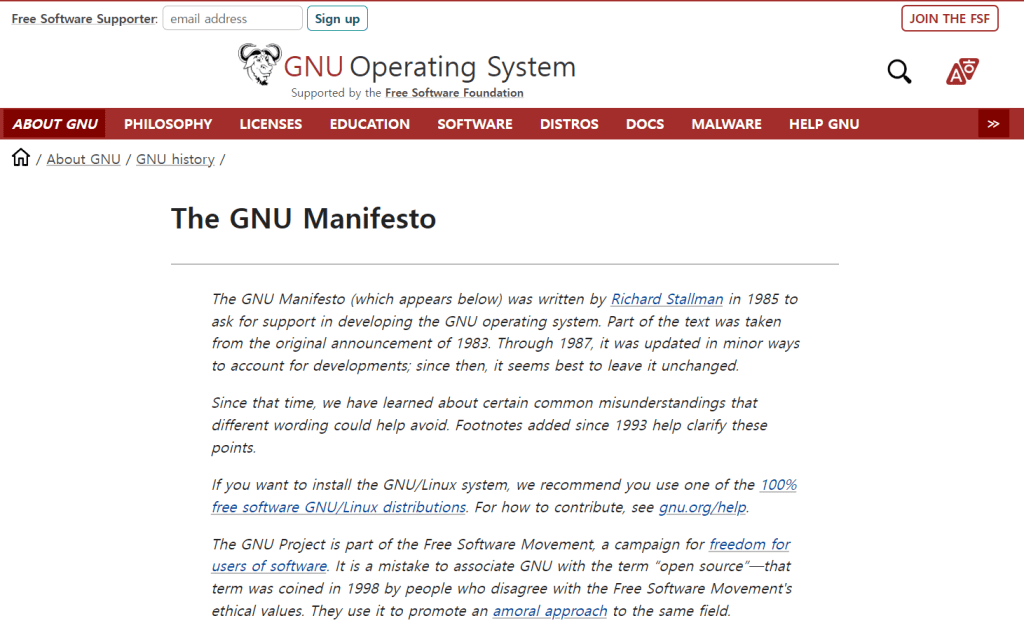
A segment of the GNU Manifesto (www.gnu.org)
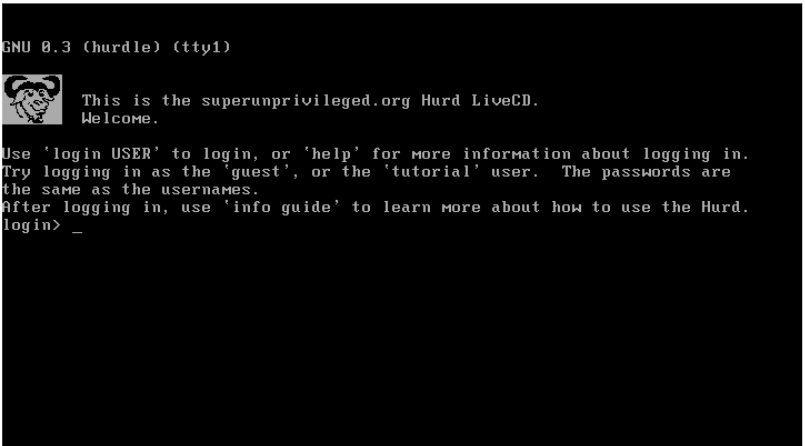
Screenshot of GNU 0.3 (http://hacktolive.org)

 IT's Story for Computer Beginners
댓글 남기기