We use the “version” to distinguish between software that was released some time ago and software released today. For instance, 2013 is the version in Microsoft Word 2013, while 4.1 is the version in NateOn 4.1.
Software companies change the version when features are changed or added to software. Just as people express their age as a number, companies record changes by updating the version. Table 2 presents a comparison of versions 4.1 and 5 of NateOn.
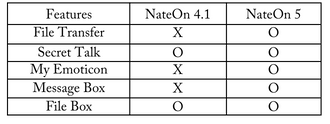
The column for version 4.1 has an “X” next to “Message Box” because it does not have that feature, whereas the column for version 5 has an “O.” The version was changed from 4.1 to 5 when features were added to NateOn. You might see the version referred to as “v4.1.” Here, “v” stands for “version.”
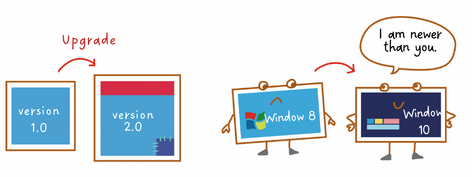
The higher the version, the later the software was released. In the case of Windows, 8 and 10 are the versions. Windows 10 was released later than Windows 8, when new features were added.
When using a computer or smartphone, you often see the word “update.” Usually, when a bug is fixed or a feature added, an update is required to replace the software with the latest version.
These days, the version is often also given a name. For example, Android version 4.0 is known as Ice Cream Sandwich, versions 4.1 to 4.3.1 are known as Jelly Bean, version 4.4 is known as KitKat, and versions 5.0 to 5.1 are known as Lollipop.
You may have seen software described as a “trial version.” The reason for making a trial version is to allow users to try the software before buying it.
If “trial version” is written next to the name of the software, it means “I am software designed for you to try.” Unlike the full version of the software, the trial version excludes certain functions or can only be used for a certain period of time.

 IT's Story for Computer Beginners
댓글 남기기